
🔥 The Countdown to BricksFolios Summer Business Internship: Capstone Demo Day Begins Now!
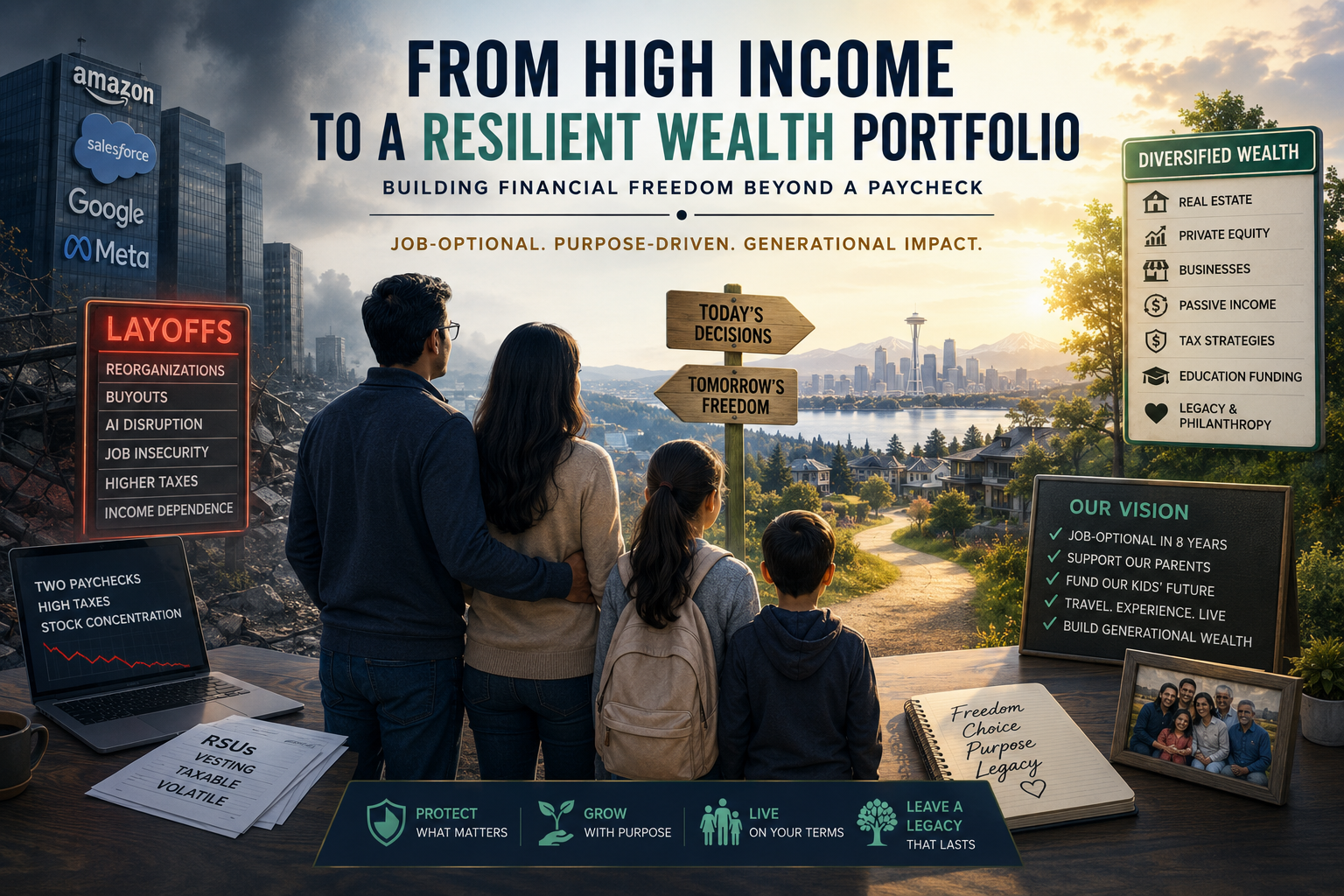
💡 From High Income to a Resilient Wealth Portfolio
Aditya and Kavita Gupta appear to be doing everything right.
They live on Seattle’s Eastside, own a beautiful home, earn strong salaries, contribute to their retirement accounts, and have built substantial positions in stocks and employer-issued equity.
Aditya is an Engineering Manager at Meta.
Kavita is a Senior Product Leader at Microsoft.
From the outside, the Guptas look financially successful.
But high income and financial freedom are not the same thing.
Almost all their income still depends on two paychecks.
A significant portion of their wealth is concentrated in technology companies, RSUs, retirement accounts, and the public stock market.
Their tax burden continues to rise.
Their lifestyle requires both incomes.
And the companies responsible for their salaries are investing heavily in artificial intelligence while simultaneously reducing teams, flattening management structures, offering buyouts, and asking fewer employees to produce more.
The risk no longer feels theoretical.
Friends from their Eastside community have been laid off or offered buyouts at Amazon, Salesforce, Google, and other major technology companies.
These are not distant headlines about people they have never met.
These are former colleagues.
Neighbors.
Parents from their children’s schools.
Friends who had respected titles, excellent résumés, years of experience, and strong performance histories.
Layoffs Are No Longer Someone Else’s Problem
In 2025, Amazon confirmed that it was eliminating approximately 14,000 corporate positions as part of an effort to reduce organizational layers, improve efficiency, and invest more aggressively in artificial intelligence.
Reports indicated that the eventual number of affected positions could reach as high as 30,000.
Source: Amazon confirms 14,000 corporate job cuts
At Salesforce, the customer-support workforce was reduced from approximately 9,000 employees to 5,000 employees.
Salesforce CEO Marc Benioff said artificial-intelligence agents were handling about half of the company’s customer interactions, changing the number and types of human roles the company believed it needed.
Source: Salesforce reduces its support workforce by approximately 4,000 positions
Friends at Google have experienced recurring reorganizations, workforce reductions, and voluntary exit programs across engineering, search, advertising, hardware, research, marketing, and other divisions.
By July 2026, more than 4,500 Google employees had signed a petition calling for stronger layoff protections, guaranteed severance, voluntary buyouts before forced layoffs, and greater transparency around performance evaluations.
Source: More than 4,500 Google employees seek stronger job protections
The layoffs force Aditya and Kavita to confront an uncomfortable truth:
A high-paying job can create a great life.
But it does not, by itself, create financial security.
The Guptas begin asking themselves:
What happens to our family’s financial plan if one of our paychecks disappears?
They are not in financial distress.
They have savings, income, home equity, and successful careers.
But they are beginning to recognize the hidden concentration in their financial life.
Their salaries, bonuses, healthcare, RSUs, retirement contributions, professional networks, and future earning potential are all connected to the same technology ecosystem.
A downturn in technology could affect their careers and investment accounts at the same time.
They have built impressive careers.
Now they must build a financial life that does not depend entirely on those careers.
👨👩👧👦 Meet the Guptas
Aditya Gupta
Engineering Manager at Meta. Analytical, disciplined, and accustomed to making complex decisions using data.
Kavita Gupta
Senior Product Leader at Microsoft. Strategic, ambitious, and increasingly concerned about taxes, job compression, and the family’s dependence on W-2 income.
Soniya, 13
Creative, curious, and beginning to think about college, entrepreneurship, and her future career.
Vihaan, 9
A technology enthusiast who loves building things and dreams of starting a company one day.
Family Vision
The Guptas want to become job-optional within eight years.
They also want to:
- Fund Soniya and Vihaan’s education without burdening them with excessive student debt.
- Support their aging parents.
- Travel without planning their lives around limited vacation days.
- Create reliable income outside their jobs.
- Reduce their dependence on technology stocks and employer equity.
- Build a portfolio of assets capable of creating lasting generational wealth.
They do not necessarily want to stop working in eight years.
They want the freedom to decide whether, where, how, and for whom they work.
⚠️ The Seven Financial Roadblocks
💰 1. Rising Tax Burden
The Guptas earn more than ever, but a substantial portion of their income disappears through federal income taxes, payroll taxes, property taxes, and other deductions.
They are also watching Washington’s tax environment change around them.
In March 2026, Washington enacted what is commonly called the “Millionaires’ Tax.”
Beginning January 1, 2028, the law imposes a 9.9% tax on Washington taxable income after a $1 million standard deduction, subject to the law’s exclusions, deductions, credits, residency rules, and other calculation requirements.
Married couples and state-registered domestic partners share one $1 million standard deduction.
The tax begins applying in 2028, with the first returns and payments generally due in 2029.
Source: Washington State Legislature, ESSB 6346
For a household such as the Guptas, the concern is not limited to base salaries.
Bonuses, vested equity, deferred compensation, stock transactions, a major liquidity event, or an unusually successful compensation year could push their taxable income significantly higher.
Washington has also increased its tax on taxable long-term capital gains.
Beginning with tax year 2025:
- The first $1 million of taxable Washington capital gains is taxed at 7%.
- Taxable Washington capital gains above $1 million are taxed at a combined rate of 9.9%.
Source: Washington Department of Revenue, tiered capital-gains tax rates
This matters because much of the Guptas’ wealth is concentrated in appreciated employer stock and public-market investments.
A future stock sale intended to diversify their portfolio could itself create a significant tax bill.
They are beginning to realize that earning more and accumulating more company stock do not automatically translate into financial freedom.
Without proactive planning, a growing share of every additional dollar may be lost to taxes.
The question is no longer simply:
How can we earn more?
It is:
How can we keep more of what we earn, invest it intelligently, and convert today’s taxable income into assets capable of supporting us tomorrow?
The Guptas understand that real estate is not automatically tax-free and that not every tax strategy will apply to their family.
But they want to understand how rental income, deductible operating expenses, depreciation, cost segregation, financing, and professional tax planning could potentially improve the efficiency of their overall portfolio.
Their eight-year timeline makes this urgent.
They cannot afford to spend the next five years accumulating more income without building the assets that could eventually replace it.
💼 2. Career Concentration Risk
Both Aditya and Kavita work for major technology companies.
Their salaries, bonuses, health insurance, RSUs, retirement benefits, professional networks, and future earning potential are tied to the same industry.
On paper, they have two incomes.
In reality, both incomes are exposed to many of the same economic and technological forces.
A downturn in technology could reduce bonuses, lower stock values, delay promotions, restrict hiring, and threaten one or both jobs at the same time.
What once felt like two independent sources of security now looks increasingly like one concentrated risk.
🤖 3. AI-Led Job Compression
Artificial intelligence may not eliminate every technology job.
But it can reduce team sizes, automate portions of highly compensated work, flatten management structures, and allow companies to produce more with fewer employees.
Aditya sees engineering teams using AI to write code, test software, document systems, analyze incidents, and accelerate product development.
Kavita sees AI being used for customer research, competitive analysis, product requirements, market analysis, presentations, and decision support.
These tools can make talented employees more productive.
They can also change how many employees a company needs.
As an Engineering Manager and a Senior Product Leader, Aditya and Kavita understand that experience and strong performance may improve their odds, but neither guarantees permanent job security.
The question is not whether AI will affect their careers.
The question is how quickly, and whether their financial life will be ready.
📉 4. Stock and RSU Exposure
A large percentage of the Guptas’ investable net worth is held in employer stock, technology funds, index funds, and retirement accounts.
They own many securities, but much of their portfolio is still influenced by the same market forces.
Their employment income rises when the technology sector performs well.
Their RSUs rise when technology stocks perform well.
Their retirement and brokerage accounts also benefit when public markets perform well.
But when technology stocks decline, several parts of their financial life can weaken simultaneously.
They may be diversified by ticker symbol.
They may not be diversified by risk.
🎓 5. Future College Costs
Soniya will begin college in approximately five years.
Vihaan will follow several years later.
The Guptas have contributed to 529 plans, but they are unsure whether their current savings will fully cover two college educations.
They do not want their children to begin adulthood burdened by excessive debt.
They also do not want college expenses to delay their own financial freedom or force them to remain dependent on demanding jobs.
They need a plan that can support education and retirement without sacrificing one for the other.
🧾 6. The W-2 Income Trap
Nearly all the family’s income is active, taxable, and dependent on continued employment.
When Aditya and Kavita work, they earn.
When they stop working, most of that income stops.
They have savings and investments, but very few assets currently produce meaningful, recurring income outside their careers.
The Guptas have been successful at earning money.
They have not yet built a system that allows their money to work independently of them.
🏠 7. Real Estate Analysis Paralysis
The Guptas believe real estate could help them diversify, create an additional income stream, improve tax efficiency, and build wealth outside the public markets.
But they do not want to buy a property simply because someone calls it a good investment.
They have many questions:
- Which markets should they consider?
- What type of rental property fits their financial position and eight-year vision?
- How much capital should they invest?
- Should they use cash savings, vested stock, home equity, or a combination of funding sources?
- Should they prioritize immediate cash flow or long-term wealth creation?
- How should they evaluate rent, financing, operating expenses, vacancy, maintenance, appreciation, depreciation, and equity growth?
- How much leverage is reasonable?
- How should they account for risk?
- How can they distinguish a promising investment from a property that merely looks attractive on Zillow?
The amount of information overwhelms them.
Doing nothing begins to feel safer than making the wrong decision.
But they are beginning to understand that doing nothing also has a cost.
🚪 The Financial Turning Point
During dinner with a close family friend, the conversation turns to layoffs, voluntary buyouts, taxes, artificial intelligence, and the rising cost of college.
Their friend asks them a simple question:
How many assets do you own that continue working when you stop working?
The room becomes quiet.
The Guptas own stocks.
They have retirement accounts.
They have equity in their primary residence.
But they do not own assets producing meaningful income outside their jobs.
Their friend explains that his family had once been in a similar position.
High salaries.
High taxes.
Heavy stock-market exposure.
Very little passive income.
No clear real estate strategy.
Then they began working with BricksFolios, a wealth-tech platform that helps busy professionals build real estate portfolios through an end-to-end, white-glove process.
He tells them:
“I used to think rental-property investing was about finding a home where the rent was higher than the mortgage.”
“Then I learned that rent minus mortgage is not investment analysis.”
“A strong investment must be evaluated across the complete picture. Income, depreciation, equity, appreciation, leverage, expenses, financing, risk, and long-term portfolio impact.”
🏡 The IDEAL Investment Framework
Their friend introduces the Guptas to the IDEAL framework:
- I . Income
- D . Depreciation
- E . Equity
- A . Appreciation
- L . Leverage
Income
Can the property produce sustainable rental income after accounting for realistic expenses, vacancy, maintenance, management, financing, and reserves?
Depreciation
Could depreciation and other eligible deductions improve the investment’s after-tax performance, subject to the family’s tax situation and professional advice?
Equity
How much mortgage principal could tenants help pay down over time, and how does that contribute to the family’s net worth?
Appreciation
Does the property have reasonable long-term appreciation potential based on location, housing demand, employment, infrastructure, supply constraints, and population trends?
Leverage
Can financing allow the Guptas to control a valuable asset without contributing the full purchase price upfront, while keeping the risk manageable?
Their friend continues:
“The goal is not simply to buy one rental property.”
“The goal is to build a portfolio in which today’s income buys assets, tenants help pay down the debt, equity creates future options, and successful assets eventually help acquire more assets.”
That idea stays with Aditya and Kavita.
🔁 Assets Buying More Assets
Income supporting future acquisitions.
Tenants contributing toward debt reduction.
Equity creating access to additional capital.
Appreciation expanding the family’s net worth.
Depreciation potentially improving tax efficiency.
Leverage allowing the family to control valuable assets without paying the entire purchase price upfront.
Multiple wealth drivers compounding in parallel.
For the first time, the Guptas begin to see real estate not merely as owning rental homes.
They see it as a potential wealth-building system.
A system that could help them move from:
- Two paychecks to multiple income streams.
- Career concentration to greater financial diversification.
- Taxable income to tax-aware investing.
- Employer dependence to greater personal control.
- Saving for retirement to building assets that could fund it.
The Guptas schedule a complimentary strategy session with BricksFolios.
Now, your team must help them determine how to begin building their real estate portfolio.
🎯 Your Capstone Challenge
Evaluate the Guptas’ financial position, goals, available capital, risk tolerance, financing options, and potential investment opportunities.
Your team must:
- Assess the family’s current financial position and concentration risks.
- Identify the opportunity cost of continuing with their current investment strategy.
- Evaluate the proposed rental property using realistic income and expense assumptions.
- Explain how the investment performs across the IDEAL framework.
- Analyze the financing strategy and use of leverage.
- Evaluate cash flow, equity growth, appreciation potential, depreciation, and long-term wealth creation.
- Identify the major risks, assumptions, and tradeoffs.
- Determine whether the property supports the family’s eight-year job-optional goal.
- Recommend realistic next steps for building a diversified real estate portfolio.
Your presentation should not simply repeat numbers.
It should explain what the numbers mean.
Show the Guptas the visible and invisible consequences of each decision.
Explain what they gain by investing.
Explain what they risk.
And explain the opportunity cost of waiting.
🔥 The Real Question
The real question is not:
Can the Guptas afford to buy an investment property?
The real question is:
Will this asset help the Guptas build a more resilient, diversified, tax-efficient, and job-optional financial future within the next eight years?
Their careers helped them earn the capital.
Now they must decide whether that capital will merely sit in their accounts, or begin working to create their freedom.


Leave a Reply