
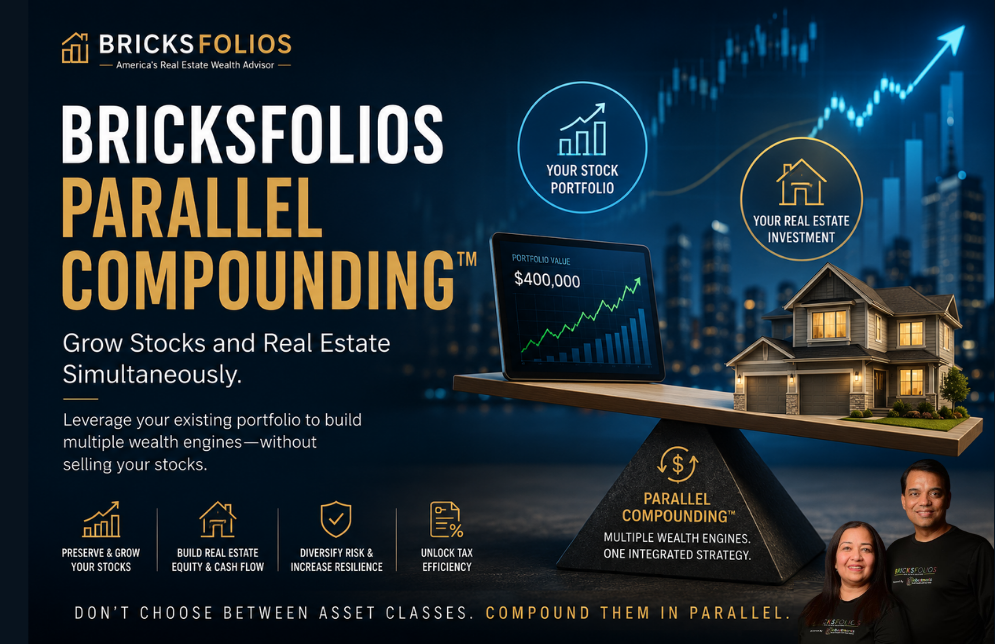
How One Pool of Capital Can Build Wealth in Stocks and Real Estate at the Same Time
Most people build wealth sequentially.
They earn money.
They save it.
They invest in stocks.
Then, when they want to buy real estate, they sell some of those stocks to fund the down payment.
One asset is liquidated to purchase another.
One wealth engine stops so another can begin.
But what if your existing assets could help acquire more assets without being sold?
That is the idea behind BricksFolios Parallel Compounding™.
Instead of stopping one investment engine to start another, BricksFolios Parallel Compounding™ is designed to keep multiple wealth engines working at the same time.
Your stocks may remain invested.
Your rental property may generate cash flow.
Your tenant help pay down the mortgage.
The property may appreciate.
Depreciation may create tax benefits.
Over time, the equity created by the property may help acquire even more assets.
Replace that paragraph with:
BricksFolios Parallel Compounding™ changes how investors think about capital allocation. Instead of evaluating stocks, real estate, leverage, taxes, and liquidity as isolated decisions, the framework coordinates them as part of one integrated wealth-building strategy. The goal is to keep existing assets compounding while strategically activating additional wealth engines.
What Is BricksFolios Parallel Compounding™?
BricksFolios Parallel Compounding™ is a wealth-building framework designed to keep an investor’s existing assets growing while using their borrowing power to acquire additional wealth-producing assets.
For example, a high-income technology professional may have substantial wealth concentrated in stocks, RSUs, or ETFs but need capital for a real estate down payment.
The conventional approach is to sell stocks.
The BricksFolios Parallel Compounding™ approach may involve using a Stock-Based Line of Credit, commonly known as an SBLOC, to access capital against eligible securities without liquidating them.
This may allow the investor to:
- Keep the stock portfolio invested and compounding
- Avoid immediately realizing embedded capital gains
- Deploy borrowed capital into carefully underwritten real estate
- Build equity through mortgage principal reduction
- Generate rental cash flow
- Benefit from potential property appreciation
- Access depreciation-related tax benefits, when eligible
- Create future borrowing power through accumulated real estate equity
The objective is simple.
Do not shut down one wealth engine to start another.
Keep both operating in parallel.
How Does BricksFolios Parallel Compounding™ Work?
Consider this example.
Starting position
- Stock portfolio: $400,000
- Approximate available SBLOC capacity at 50%: $200,000
- Amount borrowed: $175,000
- SBLOC interest rate: 4.60%
- Assumed annual stock growth: 10%
- Investment horizon: 7 years
- Existing unrealized stock gain: $60,000
The investor needs approximately $175,000 for a real estate investment.
There are two possible paths.
Option 1: Sell Stocks to Fund the Real Estate Investment
Selling the stocks would provide the required down payment.
But this decision creates two potential costs.
Capital gains taxes
In this example, the stock position contains approximately $60,000 in long-term capital gains.
At an assumed 20% federal capital gains rate, selling could create an estimated tax bill of:
$60,000 × 20% = $12,000
The actual tax liability would depend on the investor’s income, holding period, state of residence, net investment income tax exposure, and individual tax situation.
But the immediate tax bill is only the visible cost.
The larger cost may be what happens next.
Lost future compounding
Once $175,000 is removed from the stock portfolio, that capital is no longer participating in future market growth.
The investor does not merely sell $175,000 in stocks.
The investor also gives up the future value that $175,000 might have produced.
This is the difference between the seen cost and the unseen cost.
The tax bill is seen.
The future wealth that was never created is unseen.
Option 2: Borrow Against the Stock Portfolio
Instead of selling the securities, the investor borrows $175,000 through an SBLOC.
At a 4.60% annual interest rate:
Annual interest expense:
$175,000 × 4.60% = $8,050
Seven-year simple interest expense:
$8,050 × 7 = $56,350
Meanwhile, the $175,000 portion of the stock portfolio remains invested.
Assuming it compounds at 10% annually for seven years:
Future stock value: approximately $341,025
After subtracting the estimated seven-year SBLOC interest:
$341,025 − $56,350 = $284,675
This does not mean the investor earns a guaranteed $284,675 profit.
Stock returns can be lower.
Interest rates can rise.
The portfolio may decline.
The lender may require additional collateral.
But the example demonstrates the central idea.
The stock-compounding engine remains active while the real estate engine begins operating.
That is BricksFolios Parallel Compounding™.
What Does the Real Estate Wealth Pro-Forma Show?
The $175,000 borrowed through the SBLOC is then deployed into a carefully selected Smart Long-Term Rental investment.
The BricksFolios Wealth Pro-Forma used during Session 4 projected the following results after seven years:
- Total wealth: $519,259
- Cumulative cash flow: $43,169
- Equity: $476,090
- Principal paid down: $239,834
- Appreciation: $187,569
The projected total wealth of $519,259 is primarily composed of:
$476,090 in projected equity
plus
$43,169 in cumulative cash flow
That creates total projected wealth of:
$476,090 + $43,169 = $519,259
It is important not to add principal paydown, appreciation, equity, and total wealth together.
Principal paydown and appreciation are components of the equity calculation. Adding them again would count the same wealth twice.
The bigger lesson is that the property has several economic forces working simultaneously.
The tenant contributes toward the mortgage.
The mortgage balance declines.
The property may appreciate.
Rental operations may generate cash flow.
The property creates equity that may eventually be refinanced or redeployed.
This is why a rental property should not be evaluated only by asking:
“How much cash flow will I receive each month?”
A better question is:
“How much total wealth can this asset create, and how many separate forces are contributing to that outcome?”
How Much Combined Wealth Could Be Created?
Under the assumptions used in the example:
Stock-side retained value after estimated SBLOC interest
$284,675
Real estate total wealth after seven years
$519,259
Combined projected wealth outcome
$803,934
That is more than $800,000 in combined projected value across the stock and real estate strategies.
This does not mean the investor has $803,934 sitting in a bank account.
The stock value remains invested.
Much of the real estate wealth exists as equity.
Selling costs, taxes, debt balances, refinancing terms, and market conditions would affect the amount ultimately available to the investor.
But the comparison demonstrates the power of capital coordination.
By selling the stocks, the investor may activate only the real estate engine.
By borrowing conservatively against the stocks, the investor may preserve the stock engine while activating the real estate engine.
That is the core of BricksFolios Parallel Compounding™.
How Many Wealth Engines Does BricksFolios Parallel Compounding™ Create?
A rental property may look like a single investment.
In reality, BricksFolios Parallel Compounding™ may activate several distinct wealth engines.
1. Stock Portfolio Growth
The original securities remain invested.
If the portfolio appreciates, the investor continues participating in that growth.
This is the first engine.
2. Real Estate Appreciation
The property may increase in value over time.
Appreciation is not guaranteed, but location, supply, population growth, employment, schools, infrastructure, and tenant demand can influence long-term performance.
This is the second engine.
3. Mortgage Principal Reduction
Each mortgage payment includes a principal component.
As the principal balance declines, the investor’s ownership stake increases.
When rent covers the mortgage payment, the tenant is effectively helping build the owner’s equity.
This is the third engine.
4. Rental Cash Flow
After mortgage payments and operating expenses, the property may produce positive cash flow.
That cash flow may be saved, reinvested, used to service the SBLOC, or applied toward additional investments.
This is the fourth engine.
5. Tax Efficiency
Investment real estate may offer depreciation and other tax benefits.
Depending on the investor’s eligibility, strategies such as cost segregation, bonus depreciation, Real Estate Professional status, or short-term rental material participation may create meaningful tax savings.
This is the fifth engine.
6. Equity Recycling
As the property builds equity, the investor may eventually consider a HELOC, cash-out refinance, or another financing strategy.
That capital may be used to purchase another asset.
This is the sixth engine.
7. Reinvested Cash Flow
Instead of spending rental income, the investor may reinvest it.
Cash flow can help reduce debt, build reserves, pay interest, fund improvements, or contribute toward another down payment.
This becomes the seventh engine.
One well-planned capital decision may therefore activate seven interconnected wealth engines.
That is far more powerful than thinking of the strategy as simply “borrowing money to buy a rental.”
Why Is BricksFolios Parallel Compounding™ Different From Traditional Diversification?
Traditional diversification usually means spreading money across stocks, bonds, funds, companies, or sectors.
BricksFolios Parallel Compounding™ goes further.
It coordinates multiple asset classes with different wealth-building characteristics.
Stocks may provide:
- Liquidity
- Market participation
- Dividend income
- Long-term appreciation
Real estate may provide:
- Leverage
- Rental income
- Principal paydown
- Appreciation
- Depreciation
- Tax efficiency
- Equity extraction
These assets do not produce wealth in the same way.
That is the point.
A well-constructed portfolio should not depend on one company, one industry, one asset class, or one income source.
Why This Matters for High-Income Technology Professionals
Many technology professionals appear diversified because they own several accounts.
But their financial lives may still be highly concentrated.
A technology professional may receive:
- Salary from a technology company
- RSUs from the same company
- Bonuses tied to the same company
- Retirement investments weighted toward public equities
- Career risk connected to the same industry
- Home equity connected to the same regional economy
That is not always true diversification.
The salary, stock portfolio, retirement portfolio, and future earning power may all be influenced by the same economic forces.
AI-led job compression makes this risk harder to ignore.
High compensation can disappear faster than expected.
RSU values can decline.
Layoffs can happen even when performance is strong.
A portfolio concentrated in the same industry as the investor’s career may amplify risk precisely when income becomes uncertain.
BricksFolios Parallel Compounding™ may help convert part of that concentrated financial base into a separate asset class without immediately liquidating the original position.
The investor keeps exposure to public markets while building exposure to income-producing real estate.
Why Not Simply Pay Cash?
Paying cash feels safe because it avoids interest.
But avoiding interest is not always the same as maximizing wealth.
Every dollar has an opportunity cost.
Suppose an investor uses $175,000 in cash for a down payment.
That money is no longer available to:
- Compound in the stock market
- Provide emergency liquidity
- Fund another investment
- Support a business opportunity
- Serve as a reserve during a downturn
- Take advantage of future market dislocations
The correct comparison is not merely:
“How much interest will I pay?”
The more useful question is:
“What could this capital earn elsewhere, and is the expected return worth the additional risk?”
In the example, the SBLOC costs 4.60%, while the stock portfolio is assumed to grow at 10%.
That creates a projected positive spread.
But the spread is not guaranteed.
Stocks may decline.
Interest rates may rise.
The real estate investment may underperform.
BricksFolios Parallel Compounding™ should therefore be evaluated as a coordinated risk-and-return strategy, not as a shortcut to easy money.
What Is an SBLOC?
An SBLOC is a line of credit secured by eligible securities in a brokerage account.
The investor pledges stocks, ETFs, bonds, or other approved securities as collateral.
The investor may then borrow against a portion of the portfolio’s value.
An SBLOC is generally not the same as selling securities.
Because the assets are not sold, borrowing itself typically does not create a capital gain.
However, the borrower must continue meeting the lender’s collateral requirements.
If the portfolio declines significantly, the lender may demand additional collateral, require repayment, reduce the credit line, or liquidate pledged securities.
What Are the Risks of Using an SBLOC?
BricksFolios Parallel Compounding™ is not free money.
It uses leverage, and leverage must be managed carefully.
Market decline risk
If the value of the pledged securities falls, the lender may require additional collateral or partial repayment.
Variable interest-rate risk
Many SBLOCs have variable rates.
The cost of borrowing may increase even when the investment’s performance does not.
Forced-sale risk
If the investor cannot satisfy a collateral call, the lender may sell pledged securities.
This could happen during a market decline, which may lock in losses.
Real estate performance risk
The property may experience:
- Vacancy
- Unexpected repairs
- Lower-than-projected rent
- Insurance increases
- Property tax increases
- Maintenance costs
- Slower appreciation
- Tenant turnover
Liquidity mismatch
Stocks are generally liquid.
Real estate equity is not.
The investor must be prepared to service the SBLOC even when the property cannot be sold or refinanced quickly.
Concentration risk
An SBLOC secured by one or two highly concentrated stock positions may be significantly riskier than one secured by a diversified portfolio.
Behavioral risk
Access to credit can create the temptation to overborrow.
The maximum amount a lender is willing to offer is not necessarily the amount an investor should borrow.
The goal is not maximum leverage.
The goal is prudent leverage supported by reserves, stable income, conservative underwriting, and a long-term plan.
What Makes a Property Suitable for BricksFolios Parallel Compounding™?
Borrowing against a stock portfolio does not make a weak property into a good investment.
The real estate must stand on its own.
At BricksFolios, the property must be evaluated through a disciplined, data-driven lens.
Important factors include:
- Location quality
- Employment growth
- Tenant demand
- Rent durability
- School district
- Infrastructure
- New housing supply
- Purchase price
- Financing terms
- Operating expenses
- Maintenance expectations
- Insurance costs
- Cash-flow resilience
- Appreciation potential
- Principal paydown
- Tax implications
- Refinance potential
- Exit strategy
In our experience only about two percentage of properties may qualify as investment-grade.
That selectivity matters even more when leverage is involved.
Leverage magnifies outcomes.
It can amplify the performance of a strong asset.
It can also magnify the damage caused by a poor asset.
Property selection must come before financing strategy.
How Does BricksFolios Parallel Compounding™ Lead to Asset Compounding?
The first stage is Parallel Compounding.
The investor keeps the stock portfolio invested and purchases the first property.
The next stage is asset compounding.
As the property builds equity, that equity may help fund another acquisition.
The cycle may look like this:
Stock portfolio helps fund Property 1.
Property 1 creates cash flow and equity.
Equity from Property 1 helps acquire Property 2.
Properties 1 and 2 create additional cash flow and equity.
Those assets eventually help acquire Properties 3 and 4.
This is how assets begin buying more assets.
The investor is no longer relying only on salary and personal savings.
The portfolio itself becomes an acquisition engine.
That is the shift from working for money to putting assets to work.
BricksFolios 3D Wealth Stacking
BricksFolios Parallel Compounding™ is part of a broader wealth-building philosophy.
At BricksFolios, we refer to this as 3D Wealth Stacking.
The framework combines three powerful dimensions of real estate wealth creation:
Cash Flow
The property produces recurring income after expenses.
Appreciation and Equity Growth
The investor benefits from potential property appreciation and mortgage principal reduction.
Tax Efficiency
Depreciation and other eligible tax strategies may reduce taxable income and improve after-tax returns.
Many investors evaluate only one dimension.
They focus on cash flow.
Or appreciation.
Or tax savings.
But lasting wealth is often created when all three work together.
Frequently Asked Questions About BricksFolios Parallel Compounding™
What is BricksFolios Parallel Compounding™ in simple terms?
BricksFolios Parallel Compounding™ means keeping one investment growing while using its borrowing power to acquire another wealth-producing investment.
A common example is borrowing against a stock portfolio to fund a real estate down payment while leaving the stocks invested.
Do I have to sell stocks to invest in real estate?
Not necessarily.
Depending on portfolio size, collateral, lender requirements, liquidity, income stability, and risk tolerance, an investor may consider:
- An SBLOC
- A HELOC
- A cash-out refinance
- Savings
- A business line of credit
- A partnership
- Other financing sources
Each option carries different risks, costs, and tax implications.
Does an SBLOC trigger capital gains taxes?
Borrowing against securities generally does not constitute a sale.
Therefore, the act of borrowing typically does not create a capital gain.
However, a future sale of securities may create tax liability.
A qualified tax professional should evaluate the investor’s specific situation.
Can SBLOC funds be used to purchase real estate?
Lender policies vary.
Some SBLOC products may permit the funds to be used for real estate, business needs, taxes, education, or other purposes.
Many prohibit the funds from being used to purchase additional securities.
The borrower should review the lender’s permitted-use rules carefully.
Is SBLOC interest tax-deductible?
It depends on how the borrowed funds are used and how the transaction is structured and documented.
Interest tracing rules can be complex.
Investors should consult a CPA or tax attorney before assuming the interest will be deductible.
Is a 10% stock return guaranteed?
No.
The 10% annual return used in this example is an illustrative assumption.
Actual stock returns may be higher, lower, or negative.
Is the $519,259 real estate wealth projection guaranteed?
No.
The figure comes from a BricksFolios Wealth Pro-Forma based on assumptions related to rent, appreciation, expenses, financing, principal reduction, and holding period.
Actual results will vary.
Is real estate appreciation guaranteed?
No.
Property values can rise, remain flat, or decline.
A strong investment should rely on several wealth drivers rather than appreciation alone.
What is the biggest risk in Parallel Compounding?
The biggest risk is excessive leverage.
A stock market decline combined with rising interest rates or real estate underperformance could create pressure from several directions at once.
Conservative borrowing, reserves, diversification, and disciplined underwriting are essential.
Who may benefit from BricksFolios Parallel Compounding™?
The framework may be relevant for investors who:
- Own a substantial stock or ETF portfolio
- Have strong liquidity
- Maintain stable income
- Understand leverage
- Can tolerate market volatility
- Have a long investment horizon
- Are purchasing carefully underwritten real estate
- Want to diversify beyond public markets
- Have access to qualified tax, legal, financial, and lending guidance
It may not be suitable for investors with limited reserves, unstable income, concentrated stock positions, short investment horizons, or low tolerance for debt.
What Is the First Goal of an Investment?
The first goal of any investment is not to generate a monthly payment.
It is to build wealth.
Cash flow matters.
But cash flow is only one part of the picture.
A rental property may produce modest monthly cash flow while creating substantial wealth through:
- Principal reduction
- Appreciation
- Tax efficiency
- Equity growth
- Future refinancing
- Reinvested income
That is why the better question is not:
“Can I afford the payment?”
It is:
“Will this asset actually build wealth?”
The Bigger Goal: Becoming Job-Optional
BricksFolios Parallel Compounding™ is not fundamentally about an SBLOC.
It is about changing how capital works.
The traditional financial path is linear:
Earn. Save. Spend. Repeat.
The wealth-building path is different:
Earn. Save. Acquire assets. Let those assets produce income and equity. Use that income and equity to acquire more assets.
The goal is not simply to own more property.
The goal is not to have the largest brokerage statement.
The goal is to build enough independent wealth and recurring income that employment becomes a choice rather than a requirement.
That is what it means to become job-optional.
And it begins when investors stop asking:
“How much money do I have available?”
And start asking:
“How many wealth engines can this capital activate?”
Build a Coordinated Wealth Strategy
BricksFolios Parallel Compounding™ requires more than access to credit.
It requires coordination across:
- Stock concentration
- Liquidity
- Lending
- Real estate underwriting
- Property selection
- Cash-flow management
- Tax strategy
- Asset protection
- Asset management
- Risk management
- Long-term portfolio planning
BricksFolios helps high-income professionals evaluate real estate as part of a broader wealth strategy.
From portfolio planning and property selection to financing, acquisition, leasing, tax coordination, and ongoing asset management, our white-glove wealth-tech platform makes building a real estate portfolio almost as easy as investing in stocks.
Ready to explore whether BricksFolios Parallel Compounding™ belongs in your wealth plan?
📅 Book a strategy session: https://Strategy.BricksFolios.com↗️
This article is provided for educational purposes only and does not constitute investment, lending, legal, financial, or tax advice. Projections are illustrative and do not guarantee future results. Stock returns, property values, rents, expenses, interest rates, tax benefits, lending terms, and market conditions may change. Consult qualified financial, tax, legal, and lending professionals before implementing any leveraged investment strategy.
Leave a Reply